My favourite “Pothole Watcher”, Stephen, just sent me an update on one of the world’s most persistent irritations. As a follow-up to his report, I decided to look up the definition of a “pothole”, and I found one by the Michelin company which seems to fit the bill even though they might be a bit biased seeing as they, as a tire/tyre manufacturer, make a fortune out of replacing tires damaged by potholes. Stephen’s update follows:
In Horsham, West Sussex, there’s a landscape gardener who plants primroses in his local potholes. In Johannesburg, there’s a charismatic South African politician who goes snorkeling in the ones near her.
If the Mariana Trench is the deepest point on earth, the road surface that has infuriated Helen Zille, who is running to be the Johannesburg’s next mayor, can’t be far off. To highlight what she describes as the woeful management of Africa’s richest city, Zille, 75, put on her wetsuit, swim cap and snorkel mask to enter a murky abyss (Picture above).
“This wonderful snorkel pool has been here for about three years, despite many attempts to fix it,” Zille said in a video posted to social media, which showed her paddling around the giant pothole, located in the affluent suburb of Douglasdale. She complained that the authorities had repeatedly tried to repair the flooded hole, caused by a burst pipe – one attempt to fill it in had burst the pipe again!
“I can even do the backstroke over here. I wonder if there are any fishes,” Zille mused. “Neighbours can’t get out of their driveways … this is what people have to live with, in the city of Johannesburg.”
Sometimes described as South Africa’s answer to Margaret Thatcher, Zille is the former mayor of Cape Town and the former leader of the Democratic Alliance, the country’s second-largest political party. In March she announced campaign pledges in her bid to be Johannesburg’s next mayor, making the city’s deteriorating infrastructure a key part of her offer to voters, who will head to the polls in November. She has blamed three decades of dominance by the ruling African National Congress party for the crumbling state of Johannesburg, and has named water, power and enforcing bylaws as priorities. Poor service delivery in the city, which has Africa’s highest concentration of millionaires, has been compounded by a series of failed municipal coalitions, meaning no mayor since 2016 has served a full five-year term.
Zille has billed her mayoral run as “the last chance to fix Joburg” and said political elites have “used this city to extract as much capital and wealth as possible. It took 30 years to break. It’s not going to be fixed in a couple of months,” she said.
Whatever Zille’s methods, snorkel and all, she seems to have got results. Dada Morero, the current mayor of Johannesburg, said on social media that plumbing crews had fixed the burst pipe a day after Zille’s swim, and that the city’s road agency planned to fill in and repave the road by the end of the week.
MICHELIN’S DESCRIPTION OF POTHOLES:
The What, Why, and How of Potholes.
Potholes, the inevitable road distress we all love to hate – and for good reason! They are potentially hazardous and costly. But since they are inevitable, it’s time to learn the what, why, and how of potholes.
According to the American Society for Testing and Materials (ASTM) Designation 6433, potholes are ‘bowl-shaped depressions in the pavement surface’ with ‘sharp edges and vertical sides near the top of the hole.’ Technical description aside, we know them to be holes in the surface of the road that are often a nuisance while driving.
They can form on any road surface, from unpaved dirt roads to asphalt pavement. And potholes are not limited to a particular climate. While they’re often associated with cold-weather climates, they are no stranger to warm-weather regions either. Potholes cause significant damage to vehicle tires, wheels, shocks, alignment, and connected parts. A study that found the average car repair bill due to potholes is now at $406, costing US drivers a staggering $3 billion every year.
Since they are an inevitability, planning and exercising caution while driving will help you to avoid pricey vehicle repairs:
- Keep tires properly inflated with ample tread
- Inspect the vehicle’s suspension and alignment
- Keep your eyes ahead on the road and look for potholes or puddles
- Slow down safely while approaching a pothole
- Do not brake as your vehicle hits a pothole
Potholes are often the result of a combination of factors related to weather conditions and vehicle loading, otherwise known as traffic. In colder climates, the freeze-thaw cycle is the main culprit to forming potholes. When water that has seeped into the pavement or the ground underneath freezes, it expands and pushes on the pavement. As the water melts, it leaves gaps. The weight of vehicles traveling over the gaps causes them to collapse, and voila, a pothole is formed. Similarly, rain can also cause potholes. Vehicles push excess water into the pavement surface and sub-surfaces after a rainfall. Moisture weakens the surface layers and the binding agents and causes the pavement to be susceptible to cracking. As vehicles travel over cracked pavement and/or more water seeps in through the cracks, they get worse and will eventually create a pothole.
The last cause of potholes is heavy vehicle loading on pavements. This is especially common on rural or residential roads that were not constructed to support heavy vehicle traffic. Trucks with multiple axles have the exponential effect on pavement surfaces compared to regular passenger vehicles. Therefore, as trucks travel over rural or residential roads, the weight causes the pavement surface to collapse, resulting in potholes.
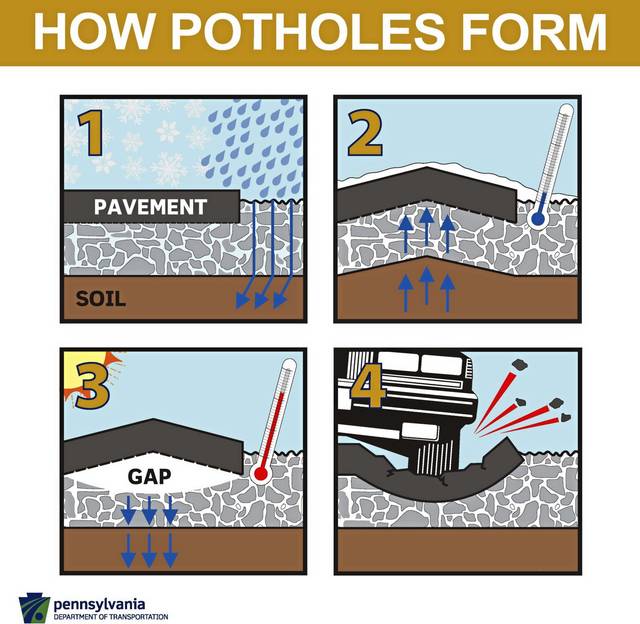
Managing a road network is a difficult and resource intensive task. In 2018, municipalities across Pennsylvania spent over $63 million on pothole repairs alone, and a recent announcement from the new mayor of New York proudly announced the “filling-in of the 100,000th pothole in that city. (I have to wonder whose job it is to keep track of how many potholes there are and what the total of “Un-filled-in ones are?
However,limited manpower, budget, and time means municipal officials often struggle to prioritize repairs and projects.”
Now, aren’t you glad you read all about potholes? I’m sure there will be future updates!