The New Forest, in the U.K., was created by William the Conqueror as a personal hunting reserve soon after his conquest of Britain in 1066. It has remained a special place ever since and, today, is a national park. The Forest is famous for its oak trees, which were the primary source of wood for the Royal Navy’s ships up to the “Age of Steam”.
“The New Forest’s King Oak is dead – now to save the Queen”.
Britain has more ancient trees than anywhere else in Europe, and one 650-year-old specimen is in urgent need of restoration; the Queen Oak at Ellingham Drove.
In the mid-14th century, the shadow of the Black Death was cast over the English countryside, Salisbury Cathedral was virtually a new build, and deep in the New Forest two oak saplings tentatively spread their roots.
In 2023, after a near-650-year steadfast union, the trees – named the King and Queen Oaks for their unusual proximity – were parted from one another. The King Oak was declared dead, with only its trunk preserved to retain a habitat for the creatures still living there.
Soil compaction from walkers and cars travelling along the adjacent road near Moyles Court on the western edge of the New Forest National Park, near Ringwood, had prevented water, nutrients and oxygen from reaching the King Oak’s roots and it could not be saved.
The Queen, thought to be one of the oldest oak trees in the UK, was at risk of suffering the same fate. But on Friday, a few weeks ago, a rescue mission was under way to give the ancient tree a new lease of life.
The extensive work is being orchestrated by The Tree Council – a charity that focuses on U.K. trees. Those involved in the project said it was often impossible to get all the relevant people involved, including land owners and environmentalists. However, it is hoped the project will prompt a nationwide movement for the protection of Britain’s ancient trees as ecological marvels and cultural symbols alike. “Ancient and veteran trees are irreplaceable ecological and cultural assets,” Jon Stokes, director of trees science and research at The Tree Council, said.
Veteran trees are those with age-related features, such as hollowing of the inside. The age range at which a tree enters this stage can vary widely even within species. Ancient trees are one stage older, usually characterised by a smaller crown – the upper portion consisting of branches and leaves – and a wider girth. “They are a feature not only of the ancient woodlands, of the open forest, a New Forest term for heathland areas, but of the villages and other settlements that have developed over time as an integral part of the forest landscape,” Stokes added.
At 8am on a recent Friday, Will Jones and his team of arborists from The Tree Management Company joined Matthew Shute, a veteran tree expert, to begin pruning the trees surrounding the Queen Oak. “The Queen” is not diseased and, due to its age, has a slow growth rate meaning pruning its branches is not preferred. Instead, arborists “halo pruned”, a process in which the younger competing trees are pared back to allow more light to reach the older tree.
Tree specialists Will Jones, Matt Shute and Jamie Fisher assessed the oak before Shute and Jones got to work.
Once that pruning process is completed, any structural failing of the tree will be addressed. The Queen Oak is almost entirely hollow, with just the outer layer sustaining life to the branches. To prevent the hollowed trunk splitting and falling, Jones and his team drilled holes to fix marine-grade stainless steel cables into a branch on one side of the tree, then connected it to the other side. This bracing process is used to support weakened or insecure limbs branches.
The methodology itself was not too difficult, Shute said, but it was rare to get everyone together with enough funding in time to solve what Shute called the “Holy Trinity” of problems plaguing ancient trees: structural failure, light and soil.
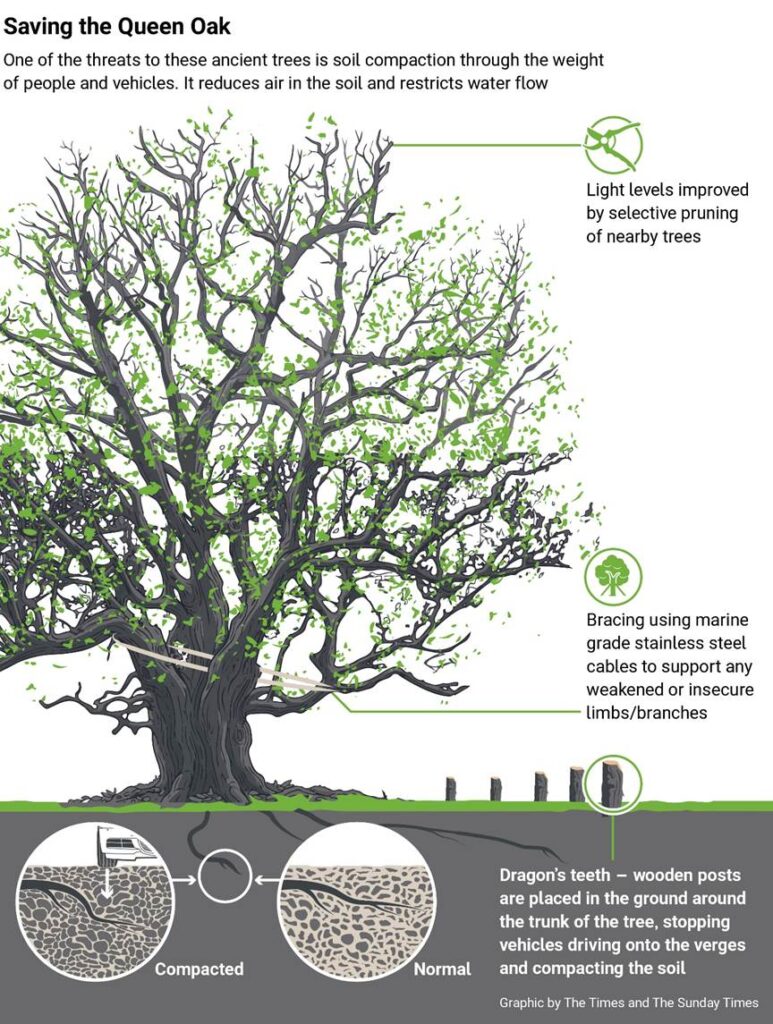
Two weeks ago, the third of those problems was addressed when the parish council funded the installation of “dragon’s teeth”, small wooden posts to keep people away from the tree and prevent cars from driving too close. Soil compaction around the tree makes it harder for the ground to retain moisture and for nutrients and oxygen to reach the tree’s roots. In total, the work costs about £5,000 – a meagre amount, the community believes, compared with the cost of losing the Queen Oak.
The UK has relatively limited tree coverage compared with European countries: only about 13 per cent compared to the EU average of 38 per cent. But it has more ancient trees than anywhere else in Europe, in part due to the relative continuity in land ownership under the monarchy and aristocracy, interrupted in Europe by various revolutions.
The protection of trees has always provoked strong reaction in Britain. Legal action is proceeding after the 500-year-old Whitewebbs Oak in Enfield, north London, was felled by contractors for the Toby Carvery restaurant chain. In July last year, Daniel Michael Graham, 39 and Adam Carruthers, 32, were jailed for four years and three months for felling the Sycamore Gap tree in September 2023. (See a previous blog).
Yet, in April last year, a report by The Tree Council for the Department for Environment, Food and Rural Affairs found that funding to protect and retain Britain’s “important trees” such as the Queen Oak marked by their “exceptionally high social, cultural, and environmental value”, was scarce.
Stokes said: “This work on the Queen Oak is groundbreaking. These trees are globally important, if they were a cathedral they would be listed. We should be investing in them.”
Oak trees support more wildlife than any other tree species in the country, according to Stokes. More than 2,000 species of animal and plant can thrive in an oak.
“It’s important culturally and ecologically, but also socially, for people that have known this tree all their lives,” James Palmer, a tree officer in the New Forest National Park, said.
Colin Andrews, 75, has lived in the New Forest for most of his life. His first job, aged 13, was as a gardener at the nearby Moyles Court School. He became interested in the ancient royal oak couple when his hedge-laying club took shade under one on a hot day. “We were horrified when the King Oak was declared dead,” Andrews said, but the work on the Queen Oak gives him hope: “It’s part of our heritage, this is such a focal point for this parish … I’ve looked at this tree and its partner for years and it means a great deal to me, alongside all the rest of the forest.”
A story worth telling, and repeating!